Is a container enclosure with a robust steel structure and a high-quality paint finish sufficient to guarantee product quality for outdoor use? Not necessarily.
During transportation and operation, containers are frequently exposed to rain, humidity, and varying weather conditions. Even a small gap in a weld, a joint between steel panels, or a door assembly can become a potential pathway for water ingress.
This is why the container enclosure water test is an important step in the product quality inspection process. So, what exactly does this test evaluate, and why should it never be overlooked?
1. Why Does a Container Enclosure Need to Undergo a Water Test?
First, it is important to understand that a container enclosure is more than just a steel structure designed to provide external protection. For specialized containers, particularly BESS containers (Battery Energy Storage System), the enclosure also serves as a protective barrier for high-value technical equipment installed inside.
Under actual operating conditions, containers may be exposed to heavy rain, water splashes, high humidity, and continuous temperature fluctuations. If the structure is not adequately sealed, water can penetrate through even the smallest openings.
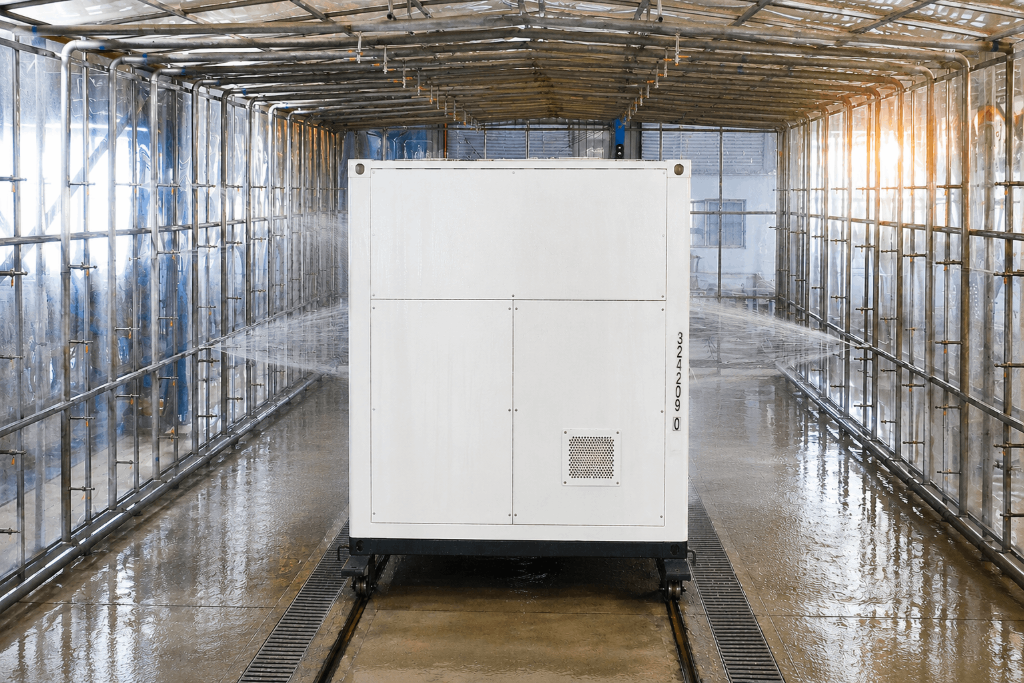
Container enclosure water testing at TaiyoEnergy's factory.
Some common causes of water leakage include:
- Inadequate weld sealing: Defects such as pinholes, cracks, or discontinuous welds can create pathways for water ingress.
- Gaps at joints and connections: Interfaces between steel panels, container corners, and structural components can become potential leakage points if they are not properly sealed.
- Door assemblies and sealing gaskets: Misaligned gaskets, uneven compression, or improper contact between sealing surfaces can allow water to penetrate.
If these issues are not detected at the factory, they can lead to several problems during operation:
Corrosion of the steel structure, affecting the container's strength and service life.
Damage to the protective coating, accelerating the oxidation process.
Damage to electrical and electronic equipment and technical systems installed inside the container.
Increased repair and maintenance costs, along with additional operational risks.
For BESS containers in particular, water ingress can affect electrical equipment and auxiliary systems installed inside. Therefore, inspecting water resistance during the manufacturing stage plays an important role in quality control.
2. What Does a Container Enclosure Water Test Actually Inspect?
Simply put, a water test involves spraying water onto designated external areas of a container under specified testing conditions, followed by an inspection to determine whether water has penetrated the enclosure.
This is not simply about spraying water onto the surface to see whether the container gets wet. The primary objective is to evaluate the sealing integrity of the structure and identify areas that may be vulnerable to water leakage.
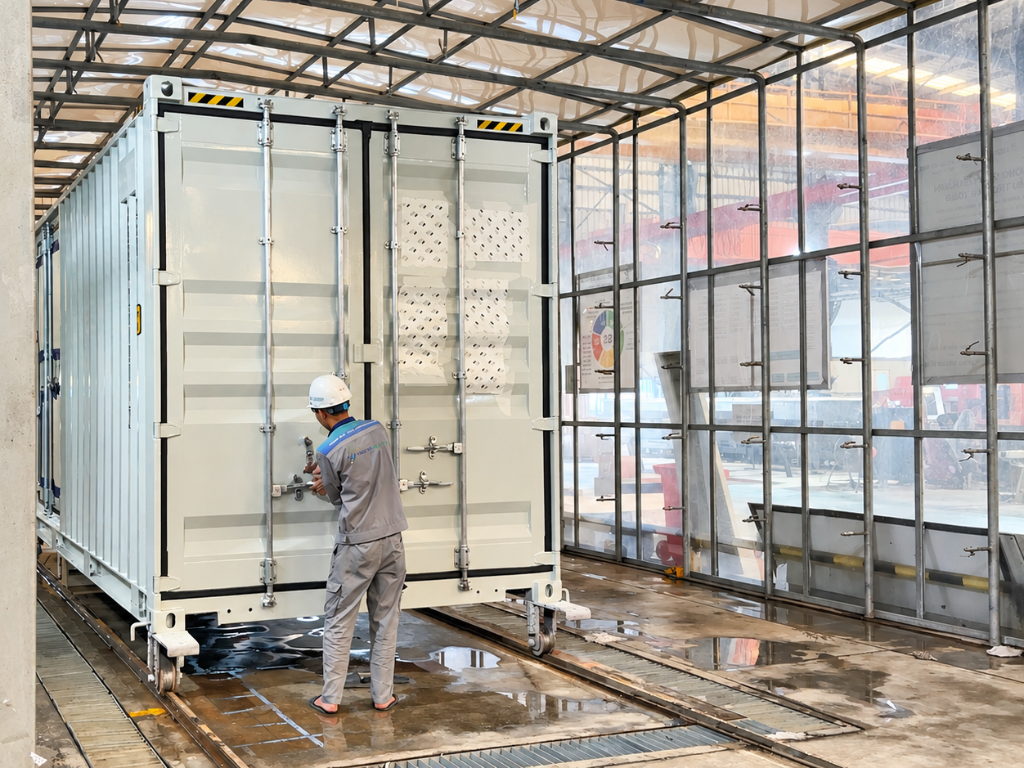
Container water ingress inspection
The inspection typically focuses on the following areas:
Weld inspection
Welds connect individual steel components to form a unified structure. Defects such as pinholes, cracks, or discontinuous welds can compromise the enclosure's ability to prevent water ingress.
Inspection of joints and container corners
These areas often involve multiple structural components coming together. If fabrication, assembly, or sealing is not properly carried out, water may penetrate through gaps.
Inspection of doors and sealing gaskets
Container doors are frequently opened and closed, so their sealing performance depends on gasket quality, door frame construction, and assembly accuracy. Testing helps identify potential leakage points when the doors are closed.
Inspection of wall penetrations and fittings
Technical openings, accessory mounting points, and connection points on the container enclosure must also be inspected to ensure they do not create pathways for water ingress.
The results of this inspection enable the quality control team to identify and address leakage points before the product is delivered.
Note: The water spraying method, pressure, spraying distance, test duration, and acceptance criteria must be determined according to the technical requirements of each project or the applicable testing standards. A conventional water test does not automatically replace IP65/IP66 ingress protection testing.
3. What Happens If a Container Is Not Tested for Water Resistance?
A product may appear to be fully finished while still containing defects that are difficult to identify through visual inspection alone.
For example, a weld may look continuous on the outside but still contain tiny pinholes. A door assembly may be correctly positioned, yet its sealing gasket may not make uniform contact with the frame. These issues may only become apparent when the container is exposed to water.
If the inspection stage is skipped, such defects may not be discovered until the product has been transported to the project site and the equipment has already been installed.
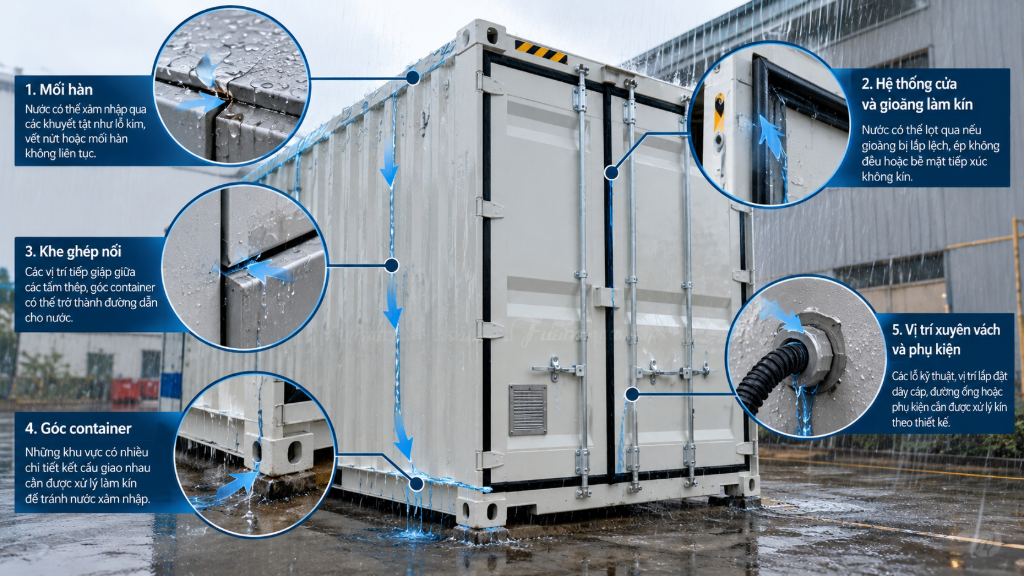
Illustration of water ingress through gaps in a container enclosure
At that point, corrective work becomes considerably more complicated. The project team may need to remove some of the installed equipment, repair the structure, restore the paint finish, and conduct additional inspections.
For BESS projects, the consequences of water ingress extend beyond damage to the container enclosure itself. Water may come into contact with electrical equipment, control systems, wiring, and internal connection components. This can cause connector corrosion, reduced electrical insulation performance, short circuits, or interruptions to equipment operation. In more severe cases, such incidents may compromise the safety and operational continuity of the entire energy storage system.
4. Container Enclosure Water Testing Process at TaiyoEnergy's Factory
At TaiyoEnergy's factory, quality inspections are emphasized throughout every stage of container enclosure manufacturing. Water testing is one of the key inspection steps used to evaluate the sealing performance of finished products before delivery.
Container enclosure water testing at TaiyoEnergy.
The inspection process can be presented through the following main steps:
Step 1: Preparing the product for testing
The container is moved to the designated testing area. Relevant components, including doors, gaskets, joints, and other areas requiring inspection, are checked to ensure they are properly finished before water spraying begins.
Step 2: Spraying water onto the container's exterior
Water is sprayed onto designated external areas according to the specified testing method and conditions. The inspection focuses on potential leakage points, including welds, container corners, door assemblies, and connection points.
Step 3: Inspecting the interior of the container
After water spraying, technical personnel inspect the interior to identify any signs of water ingress. Particular attention is paid to weld lines, floor corners, door areas, and wall penetration points.
Step 4: Evaluating the results and addressing any detected leakage
If water ingress is detected, the affected area must be identified, the cause assessed, and corrective measures implemented in accordance with the technical requirements. After repairs, the product must undergo re-inspection to verify the results.
5. Are Water Testing and IP65/IP66 Protection Ratings the Same?
These two concepts are related, but they are not identical. Water testing is a general term for testing activities designed to evaluate a product's ability to prevent water ingress under specific conditions.
Meanwhile, IP (Ingress Protection) is a protection rating system defined under the IEC 60529 standard. The IP rating indicates the level of protection provided by an enclosure against the ingress of solid objects and water.
A product that has undergone water testing at the factory does not automatically qualify for IP65 or IP66 certification.
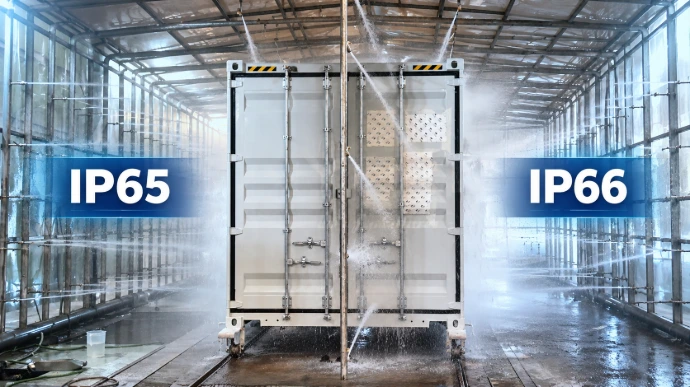
To declare an IP protection rating, a product must meet the corresponding testing methods, conditions, and assessment criteria specified by the applicable standard. For BESS container enclosures, water resistance requirements must be determined based on the design, installation location, equipment configuration, and technical specifications of each project.
Learn more: Technical Standards for BESS Containers
Conclusion
Water testing is an important inspection step that helps evaluate a container enclosure's ability to prevent water ingress and identify areas where sealing integrity may be compromised. Conducting these inspections at the factory allows defects to be detected and addressed promptly, reducing potential risks during transportation, installation, and operation.
Explore TaiyoEnergy's manufacturing capabilities and quality control processes for BESS container enclosures to find a manufacturing partner that meets your project's technical requirements.
Partner with TaiyoEnergy
Are you looking for a manufacturer of specialized container enclosures or electrical cabinet enclosures that meet international standards?
CONTACT US